Signs your tool stack has become a tangle
Businesses accumulate tools one at a time until the stack becomes a tangle no one fully understands. Here are the signs you've reached that point — and what to do.

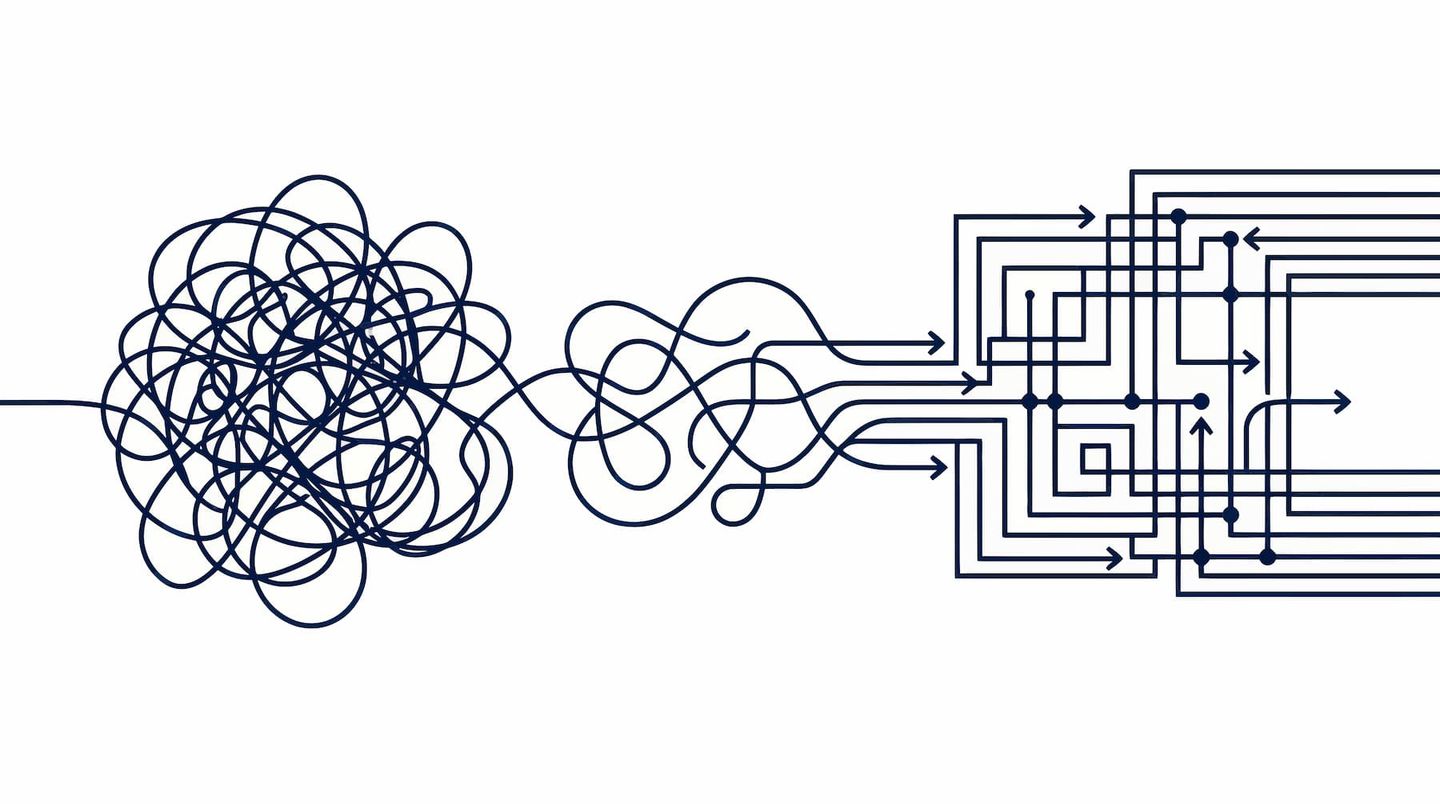
The short answer: your tool stack has become a tangle when you've accumulated so many disconnected apps that no one fully understands it, data is re-keyed everywhere, there's no single view of anything, and the total cost has quietly ballooned. It happens gradually, one tool at a time — and the signs are clear once you actually look.
The short version
- Tool stacks grow one app at a time until they tangle.
- The signs: too many tools, constant re-keying, no single view, rising cost.
- A tangle costs subscriptions, hours and errors all at once.
- Simplifying — consolidating and connecting — untangles it.
- It starts with an honest inventory of the whole stack.
What are the signs I've tangled?
There are a handful, and most tangled stacks show several at once:
- Too many tools — you'd struggle to list them all, or to say exactly what each one does.
- Re-keying everywhere — data is constantly copied between apps by hand, which is the re-keying problem in full swing.
- No single view — there's no one place that shows the whole picture of anything, so answering a simple question means checking three systems.
- Overlapping tools — several apps doing similar jobs, bought at different times by different people.
- Rising, unreviewed cost — the total software bill has grown well past any decision anyone remembers making.
- Nobody owns it — no single person is responsible for the stack as a whole, so no one's watching it drift.
If three or four of those ring true, you're not imagining it. The stack has become something that grew rather than something anyone designed.
Why do tangles form in the first place?
Each tool was a sensible fix for one problem at one time. The CRM solved a lead problem. The booking tool solved an operations problem. The spreadsheet solved a gap none of them covered. Every single decision was reasonable.
But no one steps back to look at the whole. So the stack accretes — a new app for each new need, none of them connected, redundancy creeping in as tools bought years apart end up doing overlapping jobs. The tangle isn't a mistake anyone made; it's simply what happens without deliberate stack management. Left alone, every growing business drifts this way.
Why is it worth untangling?
Because a tangled stack costs you three ways at once:
- Subscriptions — including the redundant ones you're paying for tools that overlap or barely get used.
- Re-keying hours — the time lost copying data between disconnected apps, every day.
- Errors — the mistakes that flow from copies that disagree, as covered in how integration cuts errors.
Untangling — consolidating overlapping tools and connecting the rest — cuts all three. It often frees up meaningful money on subscriptions alone, before you even count the reclaimed hours and the errors avoided. That combination is why sorting out a tangled stack tends to pay for itself faster than owners expect.
A worked example: what a tangle looks like
Picture a wholesale-and-retail business in regional Victoria that's grown over a decade. It has a point-of-sale system, an online store, a separate inventory spreadsheet, a CRM, an email marketing tool, a scheduling app, Xero for the books, and two or three shared spreadsheets holding things none of the tools quite cover. Nobody could draw how they all connect, because mostly they don't — the connections are people, carrying data from one to the next.
Stock is the giveaway. It's counted in the POS, tracked in the spreadsheet, and shown on the online store, and all three regularly disagree. So the business either oversells things it doesn't have or sits on stock the store says is gone. That single symptom — three tools holding the same data and none of them agreeing — is the tangle in miniature. It didn't come from a bad decision. It came from ten years of sensible, one-at-a-time decisions that no one ever stepped back to join up.
How does a tangle show up at BAS time?
There's a seasonal version of these signs, and it appears every quarter. If preparing your BAS means exporting from several tools, reconciling them by hand, and chasing down why the sales figure in one system doesn't match the invoices in Xero or MYOB, that's the tangle surfacing as compliance pain. A connected stack should make BAS a matter of reading numbers that are already right, not rebuilding them from scattered sources.
The same goes for end-of-year. If your accountant regularly finds that the operation and the books tell different stories — sales recorded in one place but not another, GST coded inconsistently because it was entered by hand in several systems — that's not an accounting problem, it's a stack problem. The quarterly scramble is one of the clearest signs that your tools have drifted apart and are being held together by manual effort that could be designed out.
How do I start untangling?
You don't fix a tangle by yanking on threads at random. You start by seeing the whole thing, then work through it deliberately:
- Inventory the whole stack — every tool, what it does, and what it costs.
- Spot the overlaps — where several tools could sensibly be one.
- Map the re-keying — where data is copied by hand between them.
- Consolidate and connect — fewer tools, sharing data, with the operational core on a system that fits how you work.
That last step is where the keep / integrate / replace thinking comes in: you don't rip everything out, you keep the standard tools that work, replace the ones that fight you, and connect the lot so information flows once.
The honest first step
Untangling starts with seeing the whole stack at once — which most owners have never actually done. Mapping every tool, its cost, and how data moves between them turns a vague sense of "we've got too many apps" into a clear, specific plan to simplify. The exercise itself is usually revealing: the overlaps and the re-keying jump out the moment they're laid side by side, and the path to a cleaner, connected stack becomes obvious.
Related reading
- What to keep and what to replace: a practical integration approach
- The re-keying problem: how disconnected tools waste hours
- Integrating your business systems: the complete guide
Tell us what you run, and we'll show you what's possible.