Integrating custom software with your CRM
Your CRM holds your customer relationships; your operational system runs the work. When they're connected, the whole business flows. Here's how custom software integrates with a CRM.

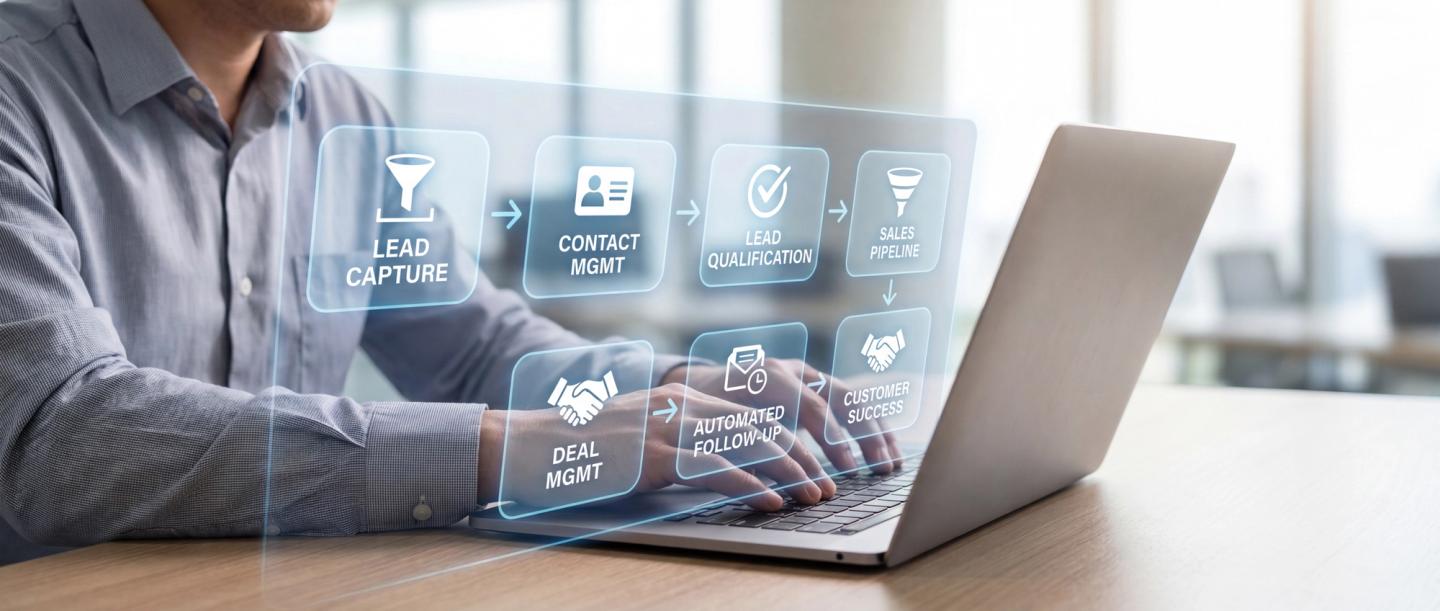
The short answer: your CRM manages relationships and your operational system runs the work — and when they're connected, a customer in one flows into the other automatically, so nobody re-enters details and everyone sees the same picture. Custom software integrates with your CRM at the boundary, keeping the CRM you know while removing the manual bridge between sales and delivery.
The short version
- A CRM holds customers and deals; your operational system runs delivery.
- Disconnected, they hold separate copies of the same customers.
- Integration lets a customer or deal flow between them automatically.
- Status flows back, so the CRM reflects what's really happening.
- You keep your CRM and connect around it — no rip-and-replace.
Where's the disconnect between a CRM and operations?
Sales lives in the CRM. The actual work lives in your operational tool — the system where jobs get scheduled, delivered and tracked. The problem is the hand-off between them.
A deal is won in the CRM, and then someone re-enters all the customer's details into the operational system to start the work. Updates on that work never make it back to the CRM, so a salesperson picking up the phone has no idea where delivery is up to. The two systems hold different versions of the same customer, and someone spends time reconciling them — or worse, no one does, and they quietly drift apart. It's a textbook case of the re-keying problem, just at the most important boundary in the business.
What does integration actually change?
- New customers flow in — a contact added once appears in both systems, not typed twice.
- Won deals start work automatically — closing a deal in the CRM kicks off delivery in the operational system, no re-keying to begin.
- Status flows back — the CRM reflects what's actually happening in operations, so sales and account managers aren't flying blind.
- One customer view — sales and delivery see the same, current picture of every customer.
The effect is that the join between winning work and doing work stops being a manual handover and becomes something that just happens. That's where a lot of dropped balls and awkward "let me check and get back to you" moments disappear.
A worked example: from won deal to done job
Take a commercial cleaning business in Perth running its pipeline in a CRM and its jobs in an operational system. A sales rep closes a deal for a new office contract. Without integration, the rep or the office manager retypes the client's name, site address, contact details and scope into the operations system to get the first clean scheduled. A week later the client rings the rep to ask when the team's starting — and the rep has no idea, because nothing from operations flows back into the CRM.
With the two connected, closing the deal creates the client and the job automatically, no re-keying. As the work is scheduled and delivered, status flows back to the CRM, so when the client rings, the rep can see the first clean is booked for Tuesday without putting anyone on hold. The rep looks on top of it because the system is. That boundary — where a sale becomes work — is exactly where connected data earns its keep.
How does this connect to accounting and GST?
The CRM-to-operations link rarely stands alone. Once a job is delivered, it needs to be invoiced, and that's where your accounting software comes in. A well-connected stack carries the thread all the way through: deal won in the CRM, job delivered in operations, invoice raised in Xero or MYOB with GST coded correctly, payment recorded back against the customer.
For an Australian business, that end-to-end flow means the same customer record underpins the sale, the delivery and the tax invoice — so there's no risk of the CRM, the job system and the books each holding a slightly different version of who the client is or what they were charged. It also makes BAS time cleaner, because every invoice traces back to a real, scheduled, delivered job rather than a figure someone re-keyed. Connecting the CRM is often the first link; connecting to your accounting software completes the chain.
Do I have to give up my CRM?
No — and you usually shouldn't. A good approach doesn't force you off a CRM that works. General-purpose CRMs are genuinely good at managing relationships and pipeline, your team knows them, and there's no prize for rebuilding that.
Custom operational software can integrate at the boundary instead. The CRM keeps doing what it's good at; your operational system handles delivery in the specific way your business works; and the two share the customer as one source of truth. You keep the familiar tool and lose the manual bridge — the best of both.
Where does custom software actually fit?
Custom software earns its place on the operational side — the specific way you deliver, which is rarely standard and rarely well served by generic tools. A general CRM handles the standard relationship management that most businesses do similarly. Integrating them gives you both: a proven CRM plus a system that fits your operation, working as one connected whole rather than two islands with a person paddling between them.
This is the same principle behind what to keep and what to replace — keep the standard thing that's done well, build custom where your business is genuinely different.
The honest first step
The right integration depends on how your sales and delivery actually hand off to each other today. Mapping that boundary — what gets re-entered, what falls through, what sales can't see — shows where the re-keying happens and what connecting the CRM to your operation would remove. It's usually one of the highest-value connections a business can make, because it sits right where money is won and work begins.
Related reading
- Integrating your business systems: the complete guide
- Integrating with your accounting software (Xero, QuickBooks, MYOB)
- What to keep and what to replace: a practical integration approach
Tell us what you run, and we'll show you what's possible.